
Exam Board
Cambridge OCR
Head of Department
Entry Requirements
Five GCSE, grade 4-9 (or equivalent)
GCSE Geography is preferred by not mandatory
Assessment Breakdown
80% exam, 20% coursework
Geography

Geography A Level explores topical and important issues that underpin the world we live in today and in the future. We examine the vital issues of climate change, social inequality, political conflict, natural hazards and global health. Students enjoy a broad curriculum that builds upon issues explored at GCSE whilst also adding to their knowledge base, new topics which are more relevant to contemporary issues.
What topics will I study?
 Paper 1 – Physical Systems (22% of the course)
- Coastal Landscapes
- Earth’s Life Support Systems
Paper 2 – Human Interactions (22% of the course)
- Migration
- Human Rights
- Changing Places
Paper 3 – Geographical Debates (36% of the course)
- Disease Dilemmas
- Hazardous Earth (tectonics)
NEA – Non-Examined Assessment (20% of the course)
 This is an independent research project written in report format in the first term of Year 13. The recommended word count is 4000 words. It must have a geographical focus based on the student’s own area of interest. In the past, students have completed various projects focused around: refugees, 20-minute towns, the impact of graffiti, coastal management and carbon cycling.
Geography outside the classroom
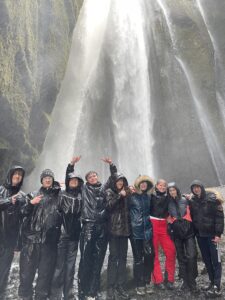
Seeing geographical phenomena outside the classroom is an exciting part of the course! We run a range of compulsory and optional fieldtrips to help gain geographical skills and bring the course to life.
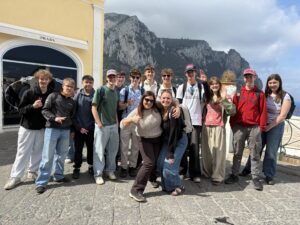
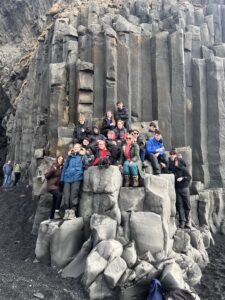
In Year 13, students can partake in an option international trip where the destination is decided based on student interest. This year we went to Sorrento, Italy where he hiked up Mount Vesuvius and saw the impacts of previous eruptions. We then took a boat trip to Capri to see stunning coastal landforms and enjoyed some of the local culture with a pizza making class. The previous year we visited Iceland to see our Eyjafjallajökull volcano case study in action and enjoy the many geographical features like geothermal lagoons and waterfalls.
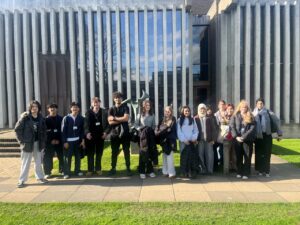
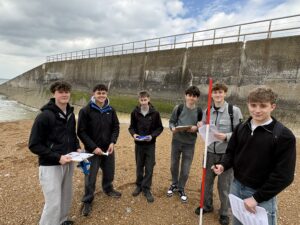
The course also includes 4 compulsory fieldwork days that are more local. In the past, these trips have been to: Battersea Power Station, Brick Lane, Rottingdean Beach, Queen Mary University of London and Kew Gardens. These trips prepare students with fieldwork and practical skills in Year 12 so that they conduct their non-examined assessment on a topic of their choice.
 What skills will I develop?
 What skills will I develop?
Skills gained in the Geography A Level are vast and highly applicable to a range of careers and interests.
Evaluation and critical thinking are invaluable skills which are developed through essay writing and applying your knowledge to different environmental contexts. Students learn how to develop and evidence their point of view in a convincing manner.
Data interpretation and analysis skills are consistently practiced throughout the course, especially within the coursework unit. Fieldwork opportunities help students demonstrate practical skills of data collection and independent project work and well as evaluating critically their own project. These are vital real-world skills applicable to any career path.
What can I do with Geography A Level?
 What can I do with Geography A Level?
Geography students are well rounded with a range of transferable skills, so are well suited to many courses. Geography degrees can be specialised in to either physical or human, or you can do a combined course. The department has a strong track record of recent Oxbridge acceptances. Geography related degrees are also very popular with student going on to study related fields such as environmental science, global development, international relations and geo-science.
Competitive sponsored degree and apprenticeship programs are an increasingly popular choice for Geography students. Recent alumni have accepted sponsored degrees with CBRE in environmental sustainability as well as apprenticeships with Savills in quantity surveying (with a renewable energy focus) and conservation apprenticeships with RHS Wisley.
Careers related to geography are vast and geographers make great employees as they able to deal with both numbers and people. Sustainability is a growing global field and as our climate is changing, more careers are available in risk and resource management. Previous students who have taken Geography A Level have also progressed to study veterinary science, medicine, physiotherapy and pilot training. This shows the mass market appeal of Geography students to the career market.
Exam Board
Cambridge OCR
Head of Department
Entry Requirements
Five GCSE, grade 4-9 (or equivalent)
GCSE Geography is preferred by not mandatory
Assessment Breakdown
80% exam, 20% coursework